
Medical CV Guide: The Best Beginner Guide (2026)
Medical CV Guide: How Mine Went From Ignored to Interview-Ready
If you’re putting together a medical CV guide checklist for yourself right now, you’re already ahead of most applicants who never think about this until after getting rejected.
I sent out 23 applications before I got my first callback. Twenty-three. Same qualifications as my classmates, same rotations, same everything — except my CV looked like a Word template from 2015 with my name in Comic Sans (yes, really, don’t ask).
Once I redid it properly, I got three interview calls in the same week I resubmitted it to places I’d already applied to before. Nothing about my experience changed—just the CV.
If you’re a medical student, fresh graduate, nurse, or any healthcare professional struggling to get callbacks despite having decent qualifications, this is everything I wish someone had shown me before I wasted months sending out a CV that was quietly killing my chances.
Why Medical CVs Are Judged Differently
A standard corporate CV primarily needs to showcase skills and achievements. A medical CV needs to show something extra — that you can be trusted with patient safety, that you follow protocol, and that your clinical judgment is sound. Recruiters and hospital HR teams read medical CVs looking for red flags first, strengths second.
That mindset shift changed how I structured mine completely.
Step 1: Get the Format Right Before Anything Else
This is the part everyone rushes through, and it’s the first thing that gets your CV rejected without anyone even reading the content.
I used to think a longer CV looked more impressive. It doesn’t — it just looks like you don’t know how to prioritize information, which itself is a red flag for clinical roles.
Step 2: Structure It the Way Recruiters Actually Read It
Medical HR staff and hospital recruiters skim CVs in under 30 seconds during the first pass. If the important stuff isn’t near the top, it might as well not exist.
Here’s the order that consistently worked for me and people I helped after:
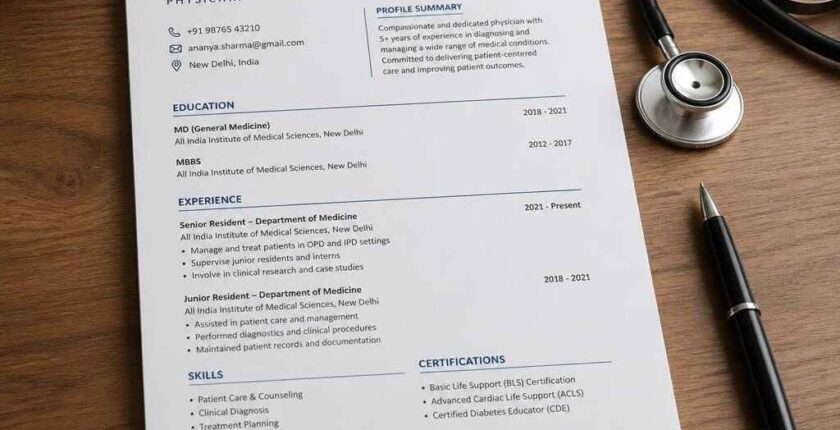
- Contact information — name, phone, email, city (no need for full home address)
- Professional summary — 2-3 lines, not a paragraph, stating your specialty and career focus
- Clinical experience — most recent first, with specific responsibilities, not vague duties
- Education and qualifications — degree, institution, graduation year
- Licenses and certifications — PMDC/PMC registration, BLS/ACLS, any specialty certifications
- Skills — clinical and technical skills relevant to the role you’re applying for
- References — “available on request” is fine, no need to list them all out
Step 3: Write Experience Like You Actually Did Something
This is where most medical CVs completely fall flat. “Assisted in patient care” tells the recruiter nothing.
Weak version (what I used to write):
“Worked in the emergency department, handled patients, assisted doctors.”
Strong version (what actually got attention):
“Managed initial assessment and triage for 15-20 patients per shift in a high-volume ER, assisted in stabilizing 3-5 critical cases weekly, and coordinated with consultants on treatment plans.”
Numbers, specifics, and actual responsibilities make the difference. Even during a rotation or internship, you did something specific — write that down instead of a generic line.
Step 4: The Certifications and Licenses Table Nobody Explains Properly
I genuinely didn’t know which certifications actually mattered until a senior doctor sat me down and explained it. Here’s the breakdown that helped.
Put these near the top if you’re applying for clinical roles — recruiters look for them almost immediately, and burying them on page 3 means they might get missed entirely.

Common Mistakes I See Constantly (Made Most of Them Myself)
- Listing every single rotation without context — nobody needs to know you did a two-week observership in dermatology unless it’s relevant to the role
- Using vague action words like “helped” or “assisted” everywhere — be specific about what you actually did
- Forgetting to tailor the CV per job — a CV for an ICU role should highlight different experience than one for outpatient clinic work
- No clear specialty or career direction stated — recruiters want to know what you’re aiming for, not just what you’ve done
- Outdated contact information — sounds obvious, but I’ve seen CVs with disconnected phone numbers still floating around
The rotation-listing mistake was mine specifically. My first CV had eleven different rotations listed with full descriptions. Nobody read past the third one.
A Simple Pre-Submission Checklist
Before you send your CV anywhere, run through this quickly:
Final Thoughts
Nobody teaches you how to write a proper medical CV in medical school or nursing school, which is strange considering how much it actually matters for getting your foot in the door. I learned it the hard way through a stack of rejections that had nothing to do with my actual clinical ability.
If your CV has been sitting there getting ignored despite decent qualifications, it might not be you — it might just be the format standing in the way. Fix that first, then everything else you’ve worked for actually gets a fair chance to be seen.